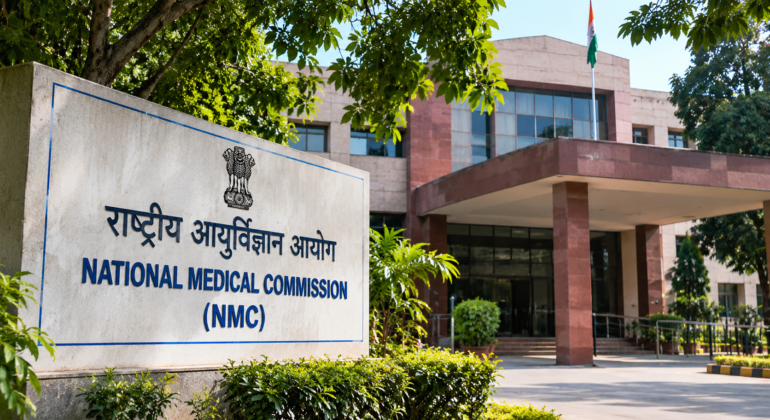

Medical colleges and research institutions across India may soon face stronger regulatory requirements for conducting experiments on laboratory animals. The National Medical Commission (NMC) has invited feedback from medical institutions on proposed regulatory changes aimed at strengthening animal welfare, improving ethical supervision and encouraging alternatives to animal testing wherever scientifically feasible.
Through a public notice issued on Monday, the NMC requested Deans, Principals and Heads of medical colleges to submit their comments, objections and recommendations to the Committee for Control and Supervision of Experiments on Animals (CCSEA) within 30 days. The draft rules were notified on September 30 and published in the Gazette of India on October 6.
Animal Welfare to Become a Central Priority
The proposed NMC draft rules on animal experiments emphasise three internationally recognised principles: replacement, reduction and refinement. These principles encourage researchers to replace animal testing with alternative scientific methods, use fewer animals wherever possible and improve experimental procedures to minimise discomfort and suffering.
The draft framework categorises experiments into four levels: non-recovery, mild, moderate and severe. Experiments expected to cause prolonged and extreme suffering that cannot be adequately relieved would not be permitted under the proposed provisions.
Mandatory Veterinary Oversight and Ethical Committees
One of the significant proposed changes is the requirement for veterinary supervision across animal research activities. Every establishment involved in animal experiments or animal breeding would need to appoint a qualified veterinarian to oversee animal health and welfare.
Institutions would also be required to establish a nine-member Institutional Animal Ethics Committee (IAEC) with a three-year tenure. The committee would include scientists, a biologist, a veterinarian and four representatives nominated by CCSEA. It would be responsible for reviewing and monitoring research activities and would need to conduct meetings at least twice annually.
Restrictions on Animal Testing and Humane Research Practices
The proposed regulations also seek to reduce the use of animal deaths as predetermined experimental endpoints. Researchers would be encouraged to adopt early humane endpoints to prevent unnecessary suffering.
Where death cannot be avoided for scientific reasons, institutions would have to minimise the number of animals involved and maintain detailed euthanasia records, including the method, dosage and justification.
Additional safeguards are proposed for experiments involving stray and feral domestic animals. The use of non-human primates would also be restricted to specific research situations where alternative animal species cannot achieve the scientific objective.
Registration and Compliance Requirements for Research Institutions
Under the proposed framework, establishments involved in breeding, housing, trading or experimenting on laboratory animals would require CCSEA registration. Regulatory inspections would take place at least twice annually to assess compliance with animal welfare requirements.
Institutions found violating the provisions could receive a 15-day notice to address deficiencies. Repeated non-compliance may result in suspension or cancellation of registration, while immediate intervention could be initiated where animal welfare faces an imminent threat.
What the Proposed Rules Mean for Medical Research
The proposed changes could introduce a more structured ethical compliance framework for India’s medical research ecosystem. Medical colleges and research establishments may need to strengthen institutional monitoring, veterinary arrangements and documentation practices.
The consultation process will allow medical institutions to communicate practical concerns before the regulatory framework moves forward. The broader objective is to support responsible scientific research while ensuring that animal welfare remains an essential consideration in laboratory-based studies.
By Healthcare Planning Infrastructure Bureau